Showing posts with label reviews. Show all posts

Wednesday, 28 August 2013

Pure by Andrew Miller

Paris, 1785. An ambitious young engineer is given the task of clearing the Cemetery of Les Innocents. What follows is a remarkable story.

With the help of a group of miners from Valenciennes, the organist from the cemetery's church, a local prostitute and the sexton's granddaughter, the engineer Baratte undertakes this remarkable feat of human endeavour. They excavate mass graves, discover mummified bodies and dismantle the church. The work is exhausting both physically and psychologically. There are other forces at work too. Mysterious graffiti links the engineer's work to growing political tensions in the capital. Change is afoot and not everyone likes it.

Miller takes the fact of the cemetery's clearance and creates a fiction that is horribly compelling. From the opening chapter in Versailles to the scene in the catacomb and the vigil in the church, there is no shortage of excitement. The book is more than a page-turner though. Life in Paris and conditions in the cemetery are vividly described with an almost cinematic effect. The impact of the work on the characters is interesting since superstitions and the power of the imagination play tricks on the mind. The threat of terrors, both real and imagined, is never far away.

Pure is one of the most enjoyable books I've read in a long time.


Friday, 21 December 2012

The Wild Places - Robert Macfarlane

'I could not now say when I first grew to love the wild, only that I did, and that a need for it will always remain strong in me. As a child, whenever I read the word, it conjured images of wide spaces, remote and figureless. Isolated islands off Atlantic coasts. Unbounded forests and blue snow-light falling on to drifts marked with the paw-prints of wolves. Frost-shattered summits and corries holding lochs of great depth. And this was the vision of a wild place that had stayed with me: somewhere boreal, wintry, vast, isolated, elemental demanding of the traveller in its asperities. To reach a wild place was, for me, to step outside human history.'

The Wild PlacesIn The Wild Places Macfarlane takes the reader on a series of journeys into some of the most remote parts of Britain and Ireland. Beginning his journey on the Llyn peninsula in Wales, he travels the length and breadth of the British Isles, from Rannoch Moor in the Highlands of Scotland to the Essex mudflats, from Croagh Patrick in Ireland to the hills and valleys of Cumbria. Each chapter is devoted to a different setting - island, valley, summit, forest, salt marsh to name but a few.

This book is a celebration of the wild, the elements and the natural world. Sleeping out in remote places and inhospitable weathers, Macfarlane experiences moments of joy but also of fear.  This book is a natural history lesson, but with literature, art and geology thrown in. The author pays tribute to those who've made a lifetime's work of studying hares, peregrine falcons, the formation of sand dunes or the movement of waves. He tells the history of the people too, from the Highland Clearances to the Irish Potato Famine. His writing is wonderfully descriptive, almost poetic, with both the eye to see and appreciate the wild places and the skill to bring them to life on the page, as here on the banks of Loch Coruisk:
'Along the north shore, we traversed acres of soaked marsh, pocked with deep sink-holes. The steep ground to our left was a mosaic of brown rock, grouted with grass and streaked vertically with water from the previous night's storm. The angle of tilt of the mountain's face and the angle of fall of the light were such that every wet face of rock was set glinting - thousands of them at once, all on the same alignment.

The sink-holes in the marsh brimmed with water. The mild ferosity of the rocks meant that the water in the holes was stained red around the edges: they shone like pools of drowned blood. Only faint deer paths showed us a safe way through.

The air was moist and smelt swampish, oozy. The ground was dense with plant-life: mare's tails, among the oldest plants in existence, and the dark green leaves of a plant whose name I did not know. I reached out and scooped one of the leaves up from beneath. It felt heavy and limp as an old vellum map, drooping loosely over my palm.'


Loch Coruisk by Marc Roberts
 
I'd always thought of myself as more of a city girl, and only really picked this up on the recommendation of another blogger. I'm very pleased I did.
'I only went out for a walk, and finally concluded to stay out till sundown, for going out, I found, was really going in.' John Muir


Friday, 14 December 2012

Uncle Petros and Goldbach's Conjecture


'Which is the most difficult problem in mathematics, Professor?' he asked Caratheodory at their next meeting, trying to feign mere academic curiosity.

'I'll give you the three main contenders,' the sage replied after a moment's hesitation. 'The Riemann Hypothesis, Fermat's Last Theorem and, last but not least, Goldbach's Conjecture, the proof of the observation about every even number being the sum of two primes - one of the great unsolved problems of Number Theory.'

Although by no means yet a firm decision, the first seed of the dream that some day he would prove the Conjecture was apparently planted in his heart by this short exchange...Its formulation had attracted him from the very first. The combination of external simplicity and notorious difficulty pointed of necessity to a profound truth.'

Goldbach proposed his Conjecture back in 1742 and it has exercised mathematicians ever since. Petros makes the problem his life's work. In the course of his mathematical quest, he rubs shoulders with some of the greatest minds of his time - Godel, Hardy, Littlewood and Alan Turing. The story is narrated by his nephew, curious to know why the rest of his family deems his uncle to be such an abject failure. 
Yes, this is a book about maths but it’s also about the goals we set ourselves in life, about how high we aim and how we respond to setbacks and failure.  It’s also about the nature of obsession and the perils of staking a lifetime's work on a single goal.  The author, himself a mathematician, gives the lay reader an insight into the great mathematical minds, highlighting the link between mathematical genius and mental instability. He points to the great mathematicians who’ve committed suicide and those who’ve finished their days as broken men.
'Sammy expounded his theory: 'I think Godel's insanity - for unquestionably he is in a certain sense insane - is the price he paid for coming too close to Truth in its absolute form. In some poem it says that "people cannot bear very much reality", or something like that. Think of the biblical Tree of Knowledge or the Prometheus of your mythology. People like him have surpassed the common measure; they've come to know more than is necessary to man, and for this hubris they have to pay.'
The young narrator, initially drawn to maths himself, ultimately decides it’s not a route he’s prepared to take.
There's very little in the way of characterisation or scene-setting, but this is a compelling and convincing story. Even as a non-mathematician I could appreciate the devastating blow dealt by Petros' encounter with Godel. We see flashes of genius and descent into madness. The end of the novel is particularly dramatic as the nephew finally succeeds in reawakening his uncle’s interest, with unintended consequences.

When the book was published in 2000, the publishers offered a $1million prize to anyone who proved the Conjecture within two years of publication. The prize went unclaimed.

Monday, 10 December 2012

December reading - Parisian nights and mathematical obsessions

With the reading room nearing completion, the thought of settling down with a book on a winter's evening has never been so appealing.

It's hardly surprising that Steinbeck's Of Mice and Men is so popular as a high school set text. Its central characters, George and Lennie, are migrant American labourers during the Great Depression. George, intelligent but uneducated, has to look out for his companion Lennie, a kindly but simple-minded giant of a man who doesn't know his own strength. From the start, Steinbeck makes us fear the worst for the unlikely duo. The pitfalls are many and we wonder how, rather than when, the two men will be undone. At a mere one hundred pages it's a quick and satisfying read. The dialogue and pace are excellent and the ending is very moving. It thoroughly deserves its place on my Classics Club list.

Inspired perhaps by Woody Allen's film Midnight in Paris, my two recent purchases have a definite Parisian flavour. My first purchase was The Ladies' Paradise which was recently televised by BBC TV. I'm intrigued to see if Zola, who wrote so convincingly about the appalling conditions of the miners in Germinal, can be equally at home in a Parisian department store. Rumour has it that there will be a Zola readalong in the new year, so this will be a good starting point.  The second was The Parisian Wife by Paula McLain. This tells the story of the troubled marriage of Ernest Hemingway and Hadley Richardson. It promises 'nights awash with absinthe in the giddy company of F.Scott Fitzgerald, Ezra Pound and Gertrude Stein.' What's not to like? Incidentally, if you haven't seen Midnight in Paris, I would recommend it.  Entirely self-indulgent, but also great fun.

My husband, The Mathematician, is often to be found with his head in a book. Generally speaking it's a maths textbook or 'How to Play Poker', but he's branched out a little recently and joined an all-male book group. Their first two choices, The Psychopath Test and Casino Royale, haven't impressed him greatly. He's been rather more taken with books on a mathematical theme. Firstly The Newtonian Casino, a true story of a group of talented physicists and mathematicians who developed an early computer to predict the results of roulette and smuggled it into Vegas casinos in the sole of their shoe. The second, Fermat's Last Theorem by Simon Singh, tells of one of the most notorious mathematical problems and the man who thought he'd solved it.  Both books have gripped TM, but on closer examination I've found them far too mathematical for my tastes. Still wanting to share in TM's enthusiasm, I chose instead Uncle Petros and Goldbach's Conjecture by Apostolos Doxiadis. This novel describes one man's obsession with a simple but dastardly challenge - to prove that every even number greater than 2 is the sum of two primes. It's proving to be an interesting insight into mathematical obsession, but not at all intimidating for a non-mathematician like me.

Last, but not least, I have our own book group choice - Oranges Are Not The Only Fruit by Jeanette Winterson. I read this many years ago and I'm looking forward to revisiting it.

All in all, an excellent month.

What's on your reading list?


Monday, 29 October 2012

Trumpet by Jackie Kay

'He was astonishingly handsome, high cheekbones that gave him a sculpted proud look; his eyes darked than any I'd ever seen. Thick black curly hair, the tightest possible curls, sitting on top of his head, like a bed of springy bracken. Neat nails, beautiful hands. I took him all in as if I had a premonition, as I knew what would happen. His skin was the colour of highland toffee.'
Millie is mourning the death of her husband. He was famous jazz trumpeter Joss Moody. He was also a woman.

Joss Moody's true identity had been kept secret for many years, even from their adopted son Colman. It was only with his death that his true identity became known.  In the weeks and months after Joss's death, we learn about this remarkable character mainly through the eyes of a number of his friends and family. Much of the story is told by his widow Millie. She recounts the day Moody revealed his true identity to her. She tells too of their long, loving relationship and her terrible loneliness after his death.
'Each time I come into this room the emptiness of it punches me in the stomach. There is something so repetitive about grief. First the stupid hope, then the violence of remembering. The hope, then the carpet from under your feet. If Joss had lived and I had died. If Joss had seen a doctor. If I had made Joss see a doctor. The same things spinning every day and night. Each night I'm afraid to sleep. I know Joss will find me. I know I will wake up and forget and then remember.'
Millie's grief is compounded by the scandal surrounding the revelation of her husband's true identity. Reeling from the shock of his parents' deception, Colman agrees to work with a tabloid journalist on a book about his father. The journalist Sophie revels in the sordid details, the deception and the search for a 'reason' for Moody's changed identity. Through Kay's skilful interweaving of the different perspectives, the reader appreciates that gender and identity are more complex and subtle than Sophie can ever understand. In this way, the binding of Moody's breasts, for example, becomes an act of great tenderness, rather than deceit.

Kay writes with great passion too on the transformative power of Moody's music:
'The music is his blood. His cells. But the odd bit is that down at the bottom, the blood doesn't matter after all. None of the particulars count for much. True, they are instrumental getting him down there in the first place, but after that they become incidental. All his self collapses - his idiosyncracies, his personality, his ego, his sexuality, even, finally, his memory. All of it falls away like layers of skin unwrapping. He unwraps himself with his trumpet. Down at the bottom, face to face with the fact that he is nobody. The more he can be nobody the more he can play that horn. Playing the horn is not about being somebody coming from something. It is about being nobody coming from nothing. The horn ruthlessly strips him bare till he ends up with no body, no past, nothing.'
The novel was inspired by the true story of Billy Tipton, an American jazz musician and a woman who passed herself off as a man. Like Joss Moody, her true identity was only discovered after her death.

Jackie Kay's novel is as tender and moving a description of grief as you could ever wish to read. She explores nuances of race, gender and identity with great sensitivity. I'd certainly recommend it.

Thursday, 11 October 2012

Swimming Home - Deborah Levy

Kitty Finch is trouble. A beautiful young woman, suffering from depression, she interrupts a family holiday in a French villa. They find her swimming naked in their pool. A double booking leaves her with nowhere to stay, so the wife of the family invites her to stay on with them. Having decided to stop taking her medication, Kitty is clearly unstable.  Her presence unsettles everyone, from the troubled poet Jozef and his poised war correspondent wife, to their adolescent daughter and the gluttonous friend with a penchant for guns.

The reader soon senses danger, but is only as the story unfolds that we realize who is most at risk.

Levy's writing disorientates the reader, just as Kitty's presence disturbs the protagonists of the story. From the very first lines Levy's prose is perceptive and unsettling:
'When Kitty Finch took her hand off the steering wheel and told him she loved him, he no longer knew if she was threatening him or having a conversation.'
Although it's hard to imagine anything beating Hilary Mantel's Bring up the Bodies to the Booker Prize, Swimming Home, with its Freudian depths, should be a strong contender.

The book is noteworthy too for its unusual publishing history. Funded by subscriptions from readers, the book is published by And Other Stories. You can find out more about the ways in which the readers influence the choice of books at http://www.andotherstories.org/

Deborah Levy is appearing at Lancaster Litfest on Sunday 21st October. You can book tickets here.


Saturday, 22 September 2012

North and South - a northern Pride and Prejudice?

This was my first book for The Classics Club Challenge.

First published in twenty weekly episodes in Dickens' Household Words in 1854, this was Gaskell's second 'industrial' novel.  Perhaps it was this connection with Dickens that led me to expect something, well, more Dickensian.  North and South appeared in the periodical directly after Dickens' Hard Times. Both novels, set in the industrial north, deal with the conditions of workers and strikers in the cotton industry.

My first mistake, I think, was to think that any other writer could be like Dickens. Who could imitate his theatrical style, grand scope and memorable characters?  I've yet to read Hard Times, but North and South surprised me by being as much a romance as it is a social commentary.

Elizabeth Gaskell
With her father's break from the church, Margaret Hale finds herself uprooted from country life and transplanted to the grim mill town of Milton in Darkshire. After the open fields of her native Helstone she finds the northern town oppressive. She is equally unimpressed by the northern merchants, particularly one Mr Thornton, a wealthy mill owner and her father's student:
"With such an expression of resolution and power, no face, however plain in feature, could be either vulgar or common. I should not like to have to bargain with him; he looks very inflexible. Altogether a man who seems made for his niche, mamma; sagacious, and strong, as becomes a great tradesman."
It is the 'tradesman' part that Margaret looks down on, for despite her own reduced circumstances, she considers herself of a higher class and better educated than he. For his part, Thornton finds Margaret haughty and proud though, as is the way with these stories, he finds herself attracted to her nonetheless.

There is more to the conflict between Margaret and Thornton than just perceived differences in class. Margaret dislikes Thornton's authoritarian attitude to his workers, whilst he considers her naive in her views on worker/master relations. It is only through the strike and Margaret's friendship with the poor Higgins family that the two begin to reconcile their views. Margaret's own family difficulties lead her into a compromising position and she discovers that she doesn't own the moral high ground after all.

Elizabeth Gaskell was in a good position to understand the hardships of the cotton workers. Having grown up, like Margaret, in the countryside, she married the minister William Gaskell and settled in Manchester where William was Minister at the Cross Street Unitarian Chapel. In addition to her writing career, she worked hard to improve the lives of the people living in the slums of Manchester.

The book considers the differences between lives of the workers in the industrial north and those living in the rural south. Margaret comes to appreciate that one is not intrinsically better than the other:
'I suppose each mode of life produces its own trials and its own temptations. The dweller in towns must find it as difficult to be patient and calm, as the country-bred man must find it to be active, and equal to unwonted emergencies. Both must find it hard to realize a future of any kind; the one because the present is so living and hurrying close around him; the other because his life tempts him to revel in the mere sense of animal existence, not knowing of, and consequently not caring for any pungency of pleasure for the attainment of which he can plan, and deny himself and look forward.'
North and South is interesting too for the way in which it explores masculine and feminine roles in Victorian society. For the most part, the female characters are limp and ineffective. There's Edith, Margaret's beautiful but spoilt cousin. She is a shallow, frivolous creature who has no sense of the world beyond her own privileged home. Margaret's mother never overcomes the shock of the move to the industrial north.  Through all the adversities heaped on the Hale family, it is Margaret that holds the family together. Guided by her own sense of right and wrong, she steps beyond the conventional boundaries of the 'feminine' sphere, first to defend Thornton against the striking workers and later in support of the cotton worker Higgins. She deals too with matters legal, working in defence of her brother who is exiled overseas. Thornton's mother is the only other strong female character, but she is fierce and judgemental. It is only Margaret who combines strength of character with real compassion for her fellow man and woman. As a modern woman reading this book, its easy to underestimate Margaret's remarkable achievements.

To be sure, despite the pride and prejudices of the two central characters, Thornton is not a romantic hero in the mould of Darcy, and nor does Gaskell's writing have the acuity and wit of Austen.  Yet the more I reflect on North and South, the more I appreciate the scope of book that has so much to say about life in Victorian England.

Saturday, 15 September 2012

Mrs Palfrey at The Claremont - Elizabeth Taylor

Mrs Palfrey is a widow, looking for a new home. She settles on The Claremont Hotel, a genteel sort of place in London where many of the guests are, like her, elderly singletons one step from the nursing home.

Life at The Claremont is not exciting. The highlight of the day is the posting of the dinner menu, and even this is the same old dishes appearing in rotation. Taylor is a wonderful observer of character, and manages to capture the essence of The Claremont's clientele quite succinctly. This is what she has to say about Mrs Palfrey herself:
'She was a tall woman with big bones and a noble face, dark eyebrows and a neatly folded jowl. She would have made a distinguished-looking man and, sometimes, wearing evening dress, looked like some famous general in drag.'
After falling in the street, Mrs Palfrey is befriended by a young man, Ludo, who spends his days writing a novel in Harrods banking hall. Embarrassed by the non-appearance of her grandson, she persuades Ludo to masquerade as her grandson and come to dinner at The Claremont.
'It was the first time since she had become a widow that she had been involved in an untruth. In fact, since early childhood, she had not lied at all except on her husband's behalf - to get Arthur out of cocktail parties which he abhorred, or to stave off importunate natives when he was tired. Now - by omission - she was trying to get away with what she thought of as a whopper, and she wondered if either she or Ludo would be equal to it.'
Elizabeth Taylor paints a wonderful picture of old age that is both sad and gently humorous. The genteel, but not always gentle, snobbery of The Claremont residents seems to belong to a bygone age, but the sense of loneliness, the aches and pains and the uncaring relatives are timeless. Taylor has a sharp eye for the comedy of their situation, which stops the book becoming maudlin, although the ending is very sad indeed.

I only heard of Elizabeth Taylor recently, but if this novel is typical of her writing I will certainly be reading more.

Saturday, 8 September 2012

The Daylight Gate - Jeanette Winterson

'The North is the dark place.
It is not safe to be buried on the north side of the church and the North Door is the way of the Dead.
The north of England is untamed. It can be subdued but it cannot be tamed. Lancashire is the wild part of the untamed.
The Forest of Pendle used to be a hunting ground, but some say that the hill is the hunter - alive in its black-and-green coat cropped like an animal pelt.
The hill itself is low and massy, flat-topped, brooding, disappeared in mists, treacherous with bogs, run through with fast-flowing streams plunging into waterfalls crashing down into unknown pools. Underfoot is the black rock that is the spine of this place.
Sheep graze. Hares stand like question marks.
There are no landmarks for the traveller. Too early or too late the mist closes in. Only a fool or one who has dark business should cross Pendle at night.
Stand on the flat top of Pendle Hill and you can see everything of the county of Lancashire, and some say you can see other things too. This is a haunted place. The living and dead come together on the hill.'
Lancaster Castle,
site of the Pendle Witch trials
Don't you think that's a wonderful opening?  I seldom pre-order books, but when I saw that Jeanette Winterson had written a novella about the Pendle Witches, I couldn't resist.

I must admit to having a particular interest in the Pendle Witches. In August 1612 the Witches were tried at Lancaster Castle and hanged just a stone's throw from my house. On a dark and stormy night I can almost imagine their cries on the wind-swept hill... You can visit the Castle and see the dungeon where the Witches were imprisoned. You can have a drink at The Golden Lion, supposed to be the final stopping point for the Witches on the way to the gallows.

The story begins on Good Friday 1612, with a mysterious gathering of thirteen people at Malkin Tower on Pendle Hill. The gathering is discovered by Roger Nowell, the local magistrate, and from here the story of the unfortunate women unfolds. Winterson does not spare the reader any of the horrors of the women's life either before or after their capture. For the most part they were superstitious, ill-treated women, victims of their own ignorance and poverty. One woman, however, does not fit this mould. She was Alice Nutter, rich widow and landowner. It is Alice's story that is at the heart of the book.

For the first few chapters I didn't know what to make of it all, but once I abandoned my own ideas and prior knowledge of the Witches I found I could properly engage with the story. Winterson combines fact with fiction, reality with witchcraft and religion. Seventeenth century England was obsessed with witchcraft and treason. The Protestant King, James I, wrote Daemonologie, supporting the practise of witch hunting. At the time, witchcraft was considered to be inextricably linked with Catholicism, or 'witchery popery popery witchery' as the lawyer Thomas Potts liked to put it. I certainly hadn't appreciated that the conspirators of the 1605 Gunpowder Plot had fled to Lancashire, making the county a prime target for accusations of witchcraft and treason.

Winterson was commissioned to write The Daylight Gate for Hammer Books. She herself says that the book was written 'as a kind of dare', to see if she could write a Hammer Horror.  There is undoubtedly horror in the book, from the Witches' macabre practices to their terrible treatment before and after their capture. Nor does Winterson spare us the horror of seventeenth-century tortures, as suffered by the Papist Christopher Southworth, Alice Nutter's lover. Strangely though, despite the horror, I will remember the book mostly as a love story. I don't want to give too much away, but if you do read the book you'll see what I mean.

I'm not sure what fans of Winterson's other writing will make of this, but as an imaginative retelling of a fascinating story, I'd certainly recommend it.


Tuesday, 28 August 2012

The Picture Book - Jo Baker


Malta, 1915. William Hastings is on shore leave from HMS Goliath where he serves as a stoker, powering the ship's engines. He's always been faithful to his wife but this time, however, he's finding the wine and women hard to resist:
'He lifts his head and watches the whore. The pretty one. The one Sully had. The way she sits, elbow on the counter, cigarette lolling from her hand. She turns, catches someone's eyes. William glances along her eyeline, to see who she's looking at. It's one of the Scots. A young lad: he stares back at her slack-jawed, hungry; hands in his pockets. There's a rash of spots across his chin. The lad's pasty fingers will be grubbing around in his pockets for money; in a minute he'll be counting out the coins on his palm. William looks back to the woman. There are deep lines down from her nose towards the corners of her lips, and they deepen as she smiles.
 He wants her. He can't help wanting her.
But he can leave. Buy a postcard. See the city. Write.
She tilts her head. Runs a finger down one edge of her wrap, where it lies over the curve of her collarbones and dips down between her breasts. He tries to think of Amelia, how he'd imagined her before they were married, when she was the girl he was waiting for. But he just recalls the red lines pinched into her skin by stays. The way she turns her head away.
There's a grain of guilt; a gritty nub of it. That's all. He stubs out his cigarette.'   


The Picture Book tells the story of four generations of a family, from the WW1 Navy man of the opening chapters to his son Billy on the Normandy landing beaches. The story moves on to Billy's son, a university lecturer, before reaching the modern day and the academic's daughter, another Billie. Each generation shares the same name, and each one is shaped in some way by those who have gone before.

Rather than tracing every stage of the family history, Baker zooms in on defining moments in the life of each generation, their decisions and indecisions and their chance encounters. For the first William it is the visit to the prostitute and an unsent postcard. For his son it is riding a bicycle in his first job as a delivery boy.

The book is at its best, I think, in its description of the relationships between the family members - the bond between  the WW2 veteran and his artistic granddaughter, the passing closeness of step brother and sister during a hasty meeting over coffee. Baker has a fine eye for the everyday details that bring her scenes to life.

The Picture Book is Baker's fourth novel and is published by Portobello.

Tuesday, 7 August 2012

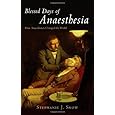
Blessed Days of Anaesthesia - Stephanie J. Snow


Product DetailsI'm pleased to say my husband took a few hours off his maths revision (he's an Open University student too) to write this review:

An interwoven story of chemistry, medicine, philosophy and religion, Blessed Days of Anaesthesia charts the remarkable changing attitudes towards pain during the nineteenth century. As pioneers of ether and chloroform start to challenge the Victorian idea that pain is a God-given stimulant, battles rage about the ethics and morality of such meddling with human consciousness. The story ebbs and flows as anaesthesia has both successes and dramatic failures. While practitioners experiment recklessly on themselves, key players take centre stage: Charlotte Bronte, Charles Dickens and Charles Darwin all become involved, and Queen Victoria herself gives birth to Prince Leopold under the influence of chloroform. Meanwhile, dark stories are emerging from London’s back-streets of nefarious activities committed with the aid of chemical-soaked handkerchiefs, and The Crimean War brings along a whole new wave of human suffering. Blessed Days of Anaesthesia is nicely written and has the intriguing subplots and interesting characters that you would hope to find in an exciting novel.

Sunday, 29 July 2012

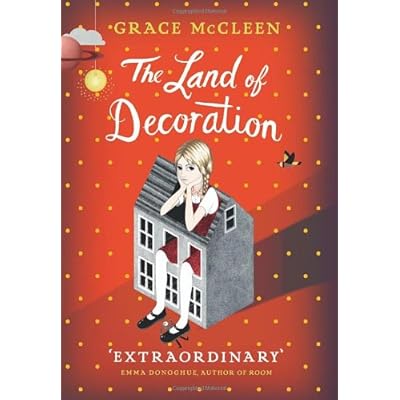
The Land of Decoration - Grace McLeen

My name is Judith McPherson. I am ten years old. On Monday a miracle happened. That is what I'm going to call it. And I did it all. It was because of what Neil Lewis said about putting my head down the toilet. It was because I was frightened. But it was also because I had faith.
The book is narrated by ten year old Judith. She and her father are members of a Christian fundamentalist sect. Her mother is dead. Judith's not like the other children and she's being bullied at school.

She seeks solace in the Land of Decoration, a miniature world built in her bedroom and inspired by the Old Testament's Promised Land. In a bid to avoid further bullying, she covers her miniature world in snow, weather which is unseasonably replicated in the real world. With this, she discovers she can perform miracles. But will anyone believe her? And will the responsibility of playing God be too much to bear?

As Judith's battle with the school bully intensifies and her father crosses the picket lines to work at the factory, her life becomes more and more complicated.

This is a moving book, both sad and funny. I liked seeing the world through Judith's eyes. She's articulate, but not unrealistically so, and her outlook is fresh and original but still innocent of the complexities of the adult world. McLeen was herself brought up in a Christian sect, and she shows us here a group whose beliefs are at odds with the world around them. Judith and her father will be tested by events in the town and will come to question all they've fought for.


Sunday, 22 July 2012

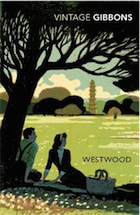
Westwood - Stella Gibbons

Poor Margaret Steggles, 'unlovely and heavy in manner, and craving for beauty both earthly and divine that could never be hers', takes a job as a school teacher in London just after the Blitz. She finds a ration book on Hampstead Heath belonging to the daughter of famous playwright Gerard Challis.

I say 'poor Margaret' because she becomes infatuated with Challis and is ruthlessly exploited by his family as an unpaid nursemaid, a position she gladly accepts to gain entry to the family home at Westwood.  Challis is oblivious to Margaret's romantic notions as, in another strand of the story, he is besotted with Margaret's down-to-earth friend Hilda.

Challis and his family are terribly shallow and pretentious and Gibbons mocks them mercilessly.  I've seldom enjoyed reading so much about such unpleasant people. 


Westwood is a very English novel, I think, and very much of its time. It's extremely class conscious, with Challis and his family looking down on Margaret, just as she, after mixing with the Westwood crowd, begins to looks down on Hilda's family.

Gibbons evokes the period well, with its rationing, air raids and American GIs. Her writing is witty, but also lyrical.
A few minutes later she stood breathing the faint breeze and gazing out across London, that beloved city, that wounded, unmartial group of villages, lying spread for mile upon mile, east and west and north and south, as far as the eye could reach, under the darkening summer sky. For the clouds had drifted away, and now every tower and dome and factory, every palace and church and stadium, stood out ghostly clear in the soft afterglow. Sometimes the myriad grey and cream tints were broken into by a dark-green mass of summer trees and occasionally, like bones, white or yellow ruins reared up.
Gibbons is, of course, best known for Cold Comfort Farm, but she wrote more than thirty books, fourteen of which are being reprinted by Virago.

Sunday, 15 July 2012

The Carhullan Army - Sarah Hall


'My name is Sister. This is the name that was given to me three years ago. It is what the others called me. It is what I call myself. Before that, my name was unimportant. I can't remember it being used. I will not answer to it now, or hear myself say it out loud. I will not sign to acknowledge it. It is gone. You will call me Sister. I was the last woman to go looking for Carhullan.'
As a result of terrible floods and a desperate energy crisis, an authoritarian government known as the 'Authority' has taken over Britain. People have been herded into the towns and cities where life is grim. Living conditions are cramped, there's no fresh food and women have enforced contraception. The only hope of having a child is winning the 'baby lottery'.
'The conditions were hard on all of us. Life changed in every way and it was difficult to adjust. There was despondency and resentment, food shortages, humiliations. Any small feeling of bliss, any cheap narcotic substance available to mask the difficulty, to make people forget what they once had, was easily sold.  In the poorest quarters people took low-grade drugs, ketamine, and hits of silverflex, which rotted their jaws. They passed syphilis among themselves and the clinics cut out tumours from the genitals of those who abused the animal tranquillisers for too long. There was almost  no money, and what little there was seemed meaningless. People traded with their bodies, their possessions, they signed up for futurised loans.'
Sister can bear the repression no longer and flees the town for Carhullan, deep in the Cumbrian hills. Carhullan is home to a community of women who live outside the law and survive by farming the land. The community is run by the charismatic, but fanatical Jackie Nixon:
'There was a fierceness about her, something amplified and internalised, an energy that my father would have described as Northern brio. Growing up in Rith, I had seen girls with this same quality. They had carried knives and had scrapped outside the school gates with little concern for their clothes and their looks, and there was an absence of teasing when they flirted with men. Jackie looked like a more mature and authentic version. Sitting beside me she seemed too inanimate for her voltage, too kinetic under her restfulness. It was as if her skin could barely contain the essence of her.'
Sister must find a way to become accepted by the women and make a new life for herself. However, she discovers that life at Carhullan is far from idyllic. She has a relationship with one of the other women, but this pleasure is shortlived. Jackie challenges Sister to show just how far she's prepared to go to preserve her new-found freedom.

This is an uncompromising book, with a strong political message. Yet there is humanity and tenderness too, and a richness of language that deserves to be admired.

Tuesday, 3 July 2012

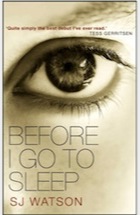
Before I Go To Sleep

Imagine waking up every morning with your memory wiped clean. You wonder who you are, where you are and who is the man lying in bed next to you. This amnesia is the problem faced by Chrissie, a middle aged married woman. Every day she must learn afresh, only to lose it all again once she goes to sleep. Then a doctor persuades her to keep a journal and slowly she begins to rebuild her life. But is everything really as it seems? Why does her husband keep so much from her?

This is the first novel by SJ Watson, an NHS audiologist, written between shifts at London St Thomas hospital. It was inspired in part by the true story of Henry Molaison, the subject of the play 2401 Objects reviewed in an earlier post.

Before I Go To Sleep is a real page-turner, hooking the reader from the very first page. Not only a well-paced thriller, it also examines the construction of memories. Just how much is actual memory and how much is confabulation?

I did enjoy this book, but I'm surprised at the effect a year of Nineteenth Century Novel study has had on me.  I missed the slow build and the opportunity to reflect as I turned the pages.

After defending genre fiction in The Reading Room's engaging debate, I'm beginning to wonder if I am a literary snob after all.

Tuesday, 26 June 2012

The Red House by Mark Haddon

A brother and sister, with their spouses and children, spend a week in a cottage in Wales. This is the starting point of The Red House by Mark Haddon, the author of the prize-winning The Curious Incident of the Dog in the Night-time. This is a simple idea, but one which belies the complicated worlds of the different characters. Although related by blood or marriage, they are very much individuals, bringing with them their own histories and crises. Occasionally their worlds touch, in moments of brief understanding, before drifting apart once more.

Angela still mourns her stillborn child, who would have celebrated her eighteenth birthday that week. Richard, a hospital consultant, is worried about a potential lawsuit. Dominic wonders whether to end his affair. The teenagers, Melissa and Daisy, form a brief but dangerous alliance.

The story is told, day by day, in the third person, with a constantly changing viewpoint. This disorientates the reader, making it hard to follow at first. The style is impressionistic, almost a stream of consciousness at times. It made me think too of Middlemarch and the 'equivalent centres of self'. So some concentration is required, but I think it is a book that well rewards the effort.

One person looks around and sees a universe created by a god who watches over its long unfurling, marking the fall of sparrows and listening to the prayers of its finest creation. Another person believes that life, in all its baroque complexity, is a chemical aberration that will briefly decorate the surface of a ball of rock spinning somewhere among a billion galaxies. And the two of them could talk for hours and find no great difference between one another, for neither set of beliefs makes us kinder or wiser.

A spot of background googling brought to light Mark Haddon's essay 'The Right Words in the Right Order' about the power of the novel to portray our inner experiences. The essay can be found in Stop What You're Doing And Read This, authors' reflections on the transformative power of reading. Contributors include Blake Morrison, Zadie Smith and Jeanette Winterson. Another one to add to my list perhaps?

Thursday, 7 June 2012

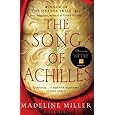
The Song of Achilles

Achilles bandaging the injured Patroclus
Madeline Miller's Orange Prize-winning novel retells the story of the Illiad through the eyes of Achilles' close companion Patroclus. Patroclus comes to the court of Achilles' father as a young boy, shamed, unnoticed and unloved, having been exiled from his own kingdom for accidentally killing another boy. He becomes Achilles' companion and then lover, following the handsome demi-god through danger and intrigue to the Trojan Wars.

I began The Song of Achilles with some trepidation. I knew very little about Greek mythology; might it all be too serious, too learned?  I needn't have worried.  It's a very readable book and the author wears her knowledge lightly. The first person fast-paced narrative quickly drew me into the story. The cast of men and gods is well drawn, especially Achilles' mother, the chilling sea goddess Thetis.

Thank you to Cornflower Books for sending me such an entertaining prize.

Tuesday, 29 May 2012

The Great Gatsby

The Roaring Twenties, Long Island, New York.

The cover of the first edition,
with the face of Daisy Buchanan.
For the wealthy few it's a time of decadence and parties, but one man's parties are more lavish than all the rest. His name is Gatsby.  No-one knows where he's come from, but some say that he killed a man.

I have the Lancashire Ladies to thank for revisiting The Great Gatsby, this month's book group choice.  I'd forgotten how much I like this book.  From the very first paragraph I knew I was in for a good time.

The excesses of the age are described with great flair, the characters are shown to be very human and very flawed.  I can imagine the parties, the fine surroundings, the jazz music and the crassness of Gatsby's guests.  I can imagine the hideous afternoon when Nick meets Tom's mistress.

There's something special about Gatsby and I must confess to be being a little in love with him. He had 'one of those rare smiles with a quality of eternal reassurance in it, that you may come across four or five times in life. It faced - or seemed to face - the whole external world for an instant, and then concentrated on YOU with an irresistible prejudice in your favor. It understood you just so far as you wanted to be understood, believed in you as you would like to believe in yourself and assured you that it had precisely the impression of you that, at your best, you hoped to convey.' I can't help thinking that the narrator, Nick Carraway, was a little in love with him too.

I don't want to give the plot away, suffice to say it's a story of love and the failure of the American dream.  Whatever Gatsby may be, he is so much better than the people around him.

I notice that Baz Luhrmann's film of The Great Gatsby due for release in Jan 2013. I can't say I'm tempted.  Although it's shot in 3D, with Leonardo di Caprio as Gatsby, I much prefer to apply my own vivid imagination to a story well told.

Sunday, 20 May 2012

Heart of Darkness

He cried in a whisper at some image, at some vision—he cried out twice, a cry that was no more than a breath—"The horror! The horror!"

The Roi des Belges, the steamboat
commanded by Conrad on the Congo in 1889
Twenty six years ago I began my A Level English Literature studies with Heart of Darkness.  As soon as I'd finished the book I turned back to the start and read it all over again.

Now it's the final text of my English Literature degree. I've reread it several times over the years since, as a novella, it's just the right length for a Sunday afternoon indulgence. Each time I read it, I find more to admire.

Marlow, the narrator for most of the book, recounts his journey as the captain of a steamboat down the Congo into the 'heart of darkness' in search of the infamous Mr Kurtz.  Conrad's vivid descriptions are based on his own experiences of the Congo and I'm never sure what is most terrifying, the oppressive jungle or the assortment of macabre colonists he meets on the way.  From the old women knitting ominously in the company office, to the immaculate Accountant or the horror of Kurtz himself, we see that the darkness is spiritual just as much as physical.  These are the 'hollow men' that inspired T.S. Eliot's poem.

The Nigerian author Chinua Achebe attacked the book as racist. Whilst Conrad is critical of European colonialism, Africans in the book are dehumanized and, at best, described as noble savages.

I can't disagree with Achebe's criticism, but as a work of immense power and a vivid account of the effects of colonialism, I can't think of a better read.

Wednesday, 9 May 2012

Guilty pleasures

Thirty years ago you might have found me reading under the covers.  Nothing too shameful - Orwell perhaps, Dickens or Mills and Boon historical.  I don't have to hide under the covers any more, but the sense of indulging guilty pleasures still persists. This is with good reason since I should be finishing my essay on Victorian deathbed scenes but hey, everyone deserves a break now and then.

The first of this week's indulgences was How It All Began.  I have a fellow blogger - dovegreyreader I think - to thank for introducing me to Penelope Lively.
Charlotte's mugging sets off a train of potentially life-changing events for those around her.  I was surprised to discover that this is such a recent book since, to me, it has a distinctly old-fashioned feel. There's plenty of telling rather than showing, but the character sketches are entertaining and all in all it is a very enjoyable read.

The Snow Child by Eowyn Ivey had been on my wishlist for some time and I was not disappointed. An impulse buy meant I read it on my Kindle, rather than having the pleasure of the beautiful paper edition, hard backed with a silvery design like the book of Russian folk tales featured in the story. My loss, I think. An aging childless couple, battling the elements to settle in Alaska, build a child out of snow.  The snow child becomes a beautiful girl, but is she real?  I certainly wanted to believe.  Whereas The Shipping News gave us the bitter cold of small town Newfoundland, The Snow Child evokes the rhythm of the seasons and the natural world.  A lovely book.

Next on my list will be my unexpected prize from Litlove,  The Song of Achillesa retelling of the Illiad.   The last time I won anything I was a ten year-old Bo Peep, so this was an excellent surprise.

These recent reads have certainly rekindled my interest in non-course reading.  Just five more weeks of academic study and then I can read to my heart's content.  I'm counting the days.

Long time, no see

I blame Facebook. And Twitter. And Whatsapp. Not to mention Cooking Fever and Candy Crush, both of which I've installed and deleted from...